

Saint Thomas Aquinas
the Angelic Doctor

Step into any chapel enveloped in the mystery of Eucharistic Adoration, and you’ll discover a living current that pulses through over two millennia of Catholic devotion. At its very heart stands Saint Thomas Aquinas—the Angelic Doctor—whose towering intellect and burning love for the Real Presence continue to shape the Church’s deepest understanding of the Eucharist. For the faithful, Aquinas is more than a medieval theologian; he is a guide, poet, spiritual father, and defender of the Eucharist as the “Source and Summit of Faith” (Catechism 132), a truth championed by Journeys of Faith.
Here, in these pages, we turn with reverence to the life and legacy of Saint Thomas Aquinas, the master who united reason with revelation and whose hymns anoint our liturgies even today. Through his passionate words, drawn ever from Sacred Scripture and in complete fidelity to the Catholic Magisterium, Aquinas ignites our hunger for heaven and sanctity. On every virtual pilgrimage offered by Journeys of Faith, his legacy lights the way, calling us to adore, contemplate, and receive Christ Himself in the sacrament of the altar.
In this article, we invite you—fellow pilgrims, devotees of the saints, and seekers nourished by the Eucharist—to discover how Saint Thomas Aquinas became the Angelic Doctor of the Eucharist. Let us journey together, One Heart, One Mind, One Spirit, With One Vision, toward a deeper encounter with the mystery that is both the source and summit of our life in Christ.
Early Life and Dominican Calling
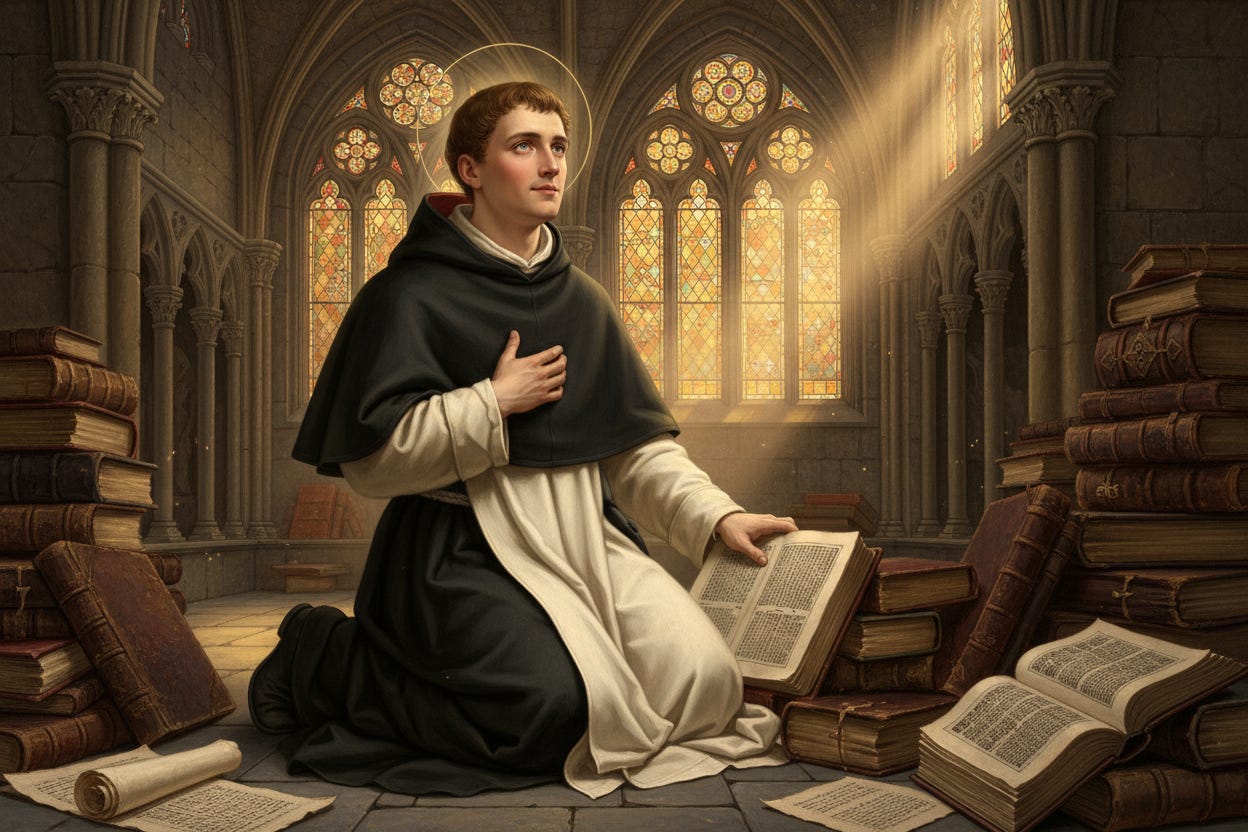
Born in 1225 at the family castle of Roccasecca, in the Kingdom of Sicily, Thomas Aquinas was marked from a young age by a fervor for Truth and a precocious, contemplative spirit. The youngest son of Landulf, Count of Aquino, and Theodora, from the noble lineage of the Counts of Teano, Thomas’s early formation was steeped in the monastic traditions of the nearby Abbey of Monte Cassino, Benedictine heartland where Gregorian chant and orderly devotion to God filled each day.
Even as a child, Thomas exhibited remarkable intellect and spiritual hunger. By the age of five, he was entrusted to the care of the Benedictines at Monte Cassino, where he first encountered the rhythm of prayer, study, and silence. There, his gentle demeanor and insightful questions hinted at a soul destined for lofty pursuits. It was during these formative years that Thomas became acquainted with the sacred mysteries of the Eucharist—a devotion that would blaze throughout his life and scholarship.
At the University of Naples, Aquinas’s search for wisdom intersected with the burgeoning Dominican order—a band of preachers, mendicants, and scholars, founded by Saint Dominic, passionate about fidelity to Holy Scripture and fervent witness for Christ. Thomas encountered these friars at a time when the Dominicans, garbed in simple black and white, made an indelible impression on his heart. For Thomas, their disciplined devotion to study, combined with their zeal for the salvation of souls, echoed the Gospel mission to “go and make disciples of all nations” (Matthew 28:19).
Against the wishes of his powerful family, who envisioned a more prestigious ecclesiastical future for him, Thomas responded to God’s call, receiving the habit of Saint Dominic. Undeterred even by abduction and imprisonment by his brothers—who sought forcibly to redirect his path—he remained steadfast, embedding himself deeper in prayer and meditating ceaselessly on the Passion and the Real Presence of Christ in the Eucharist.
It is clear that Aquinas’s Dominican calling was not merely a career choice, but an act of surrender—one heart, one mind, one spirit, united with Christ. From these humble beginnings would emerge the Angelic Doctor, whose love for the Eucharist would flood the world with golden light.
Deepen Your Faith with Journeys of Faith
Are you inspired by the life and teachings of Saint Thomas Aquinas? Do you long to enrich your devotion to the Most Holy Eucharist and the saints who bore witness to its power? At Journeys of Faith, we invite you to embark on a spiritual journey that echoes the reverence and passion of the Angelic Doctor himself. Rooted firmly in loyalty to the Magisterium and imbued with scriptural truth, our mission is to walk with you as you pursue sanctification and a deeper encounter with Christ.
Join us on this sacred pilgrimage:
Explore Virtual Pilgrimages: Encounter the stories of Eucharistic miracles, Marian apparitions, and the lives of saints like Saint Thomas Aquinas from the comfort of home.
Visit Our Gift Shop: Find handpicked religious articles, books, statues, and unique sacramentals crafted to lift your spirit heavenward.
Retreat & Reflection: Discover tranquility at the Saint Joseph Retreat Center or meditate on the mysteries of Christ along our outdoor Way of the Cross and Rosary.
Support Catholic Evangelization: Every purchase and donation fuels our 501(c)(3) mission—to spread the truth that the Eucharist is the Source and Summit of our faith.
Let us walk together “One Heart, One Mind, One Spirit, With One Vision!” — nurturing devotion, grounding it in the wisdom of Saint Thomas Aquinas, and guiding you ever closer to the Heart of Jesus.
Saint Thomas Aquinas Collection
Formation under Saint Albert the Great
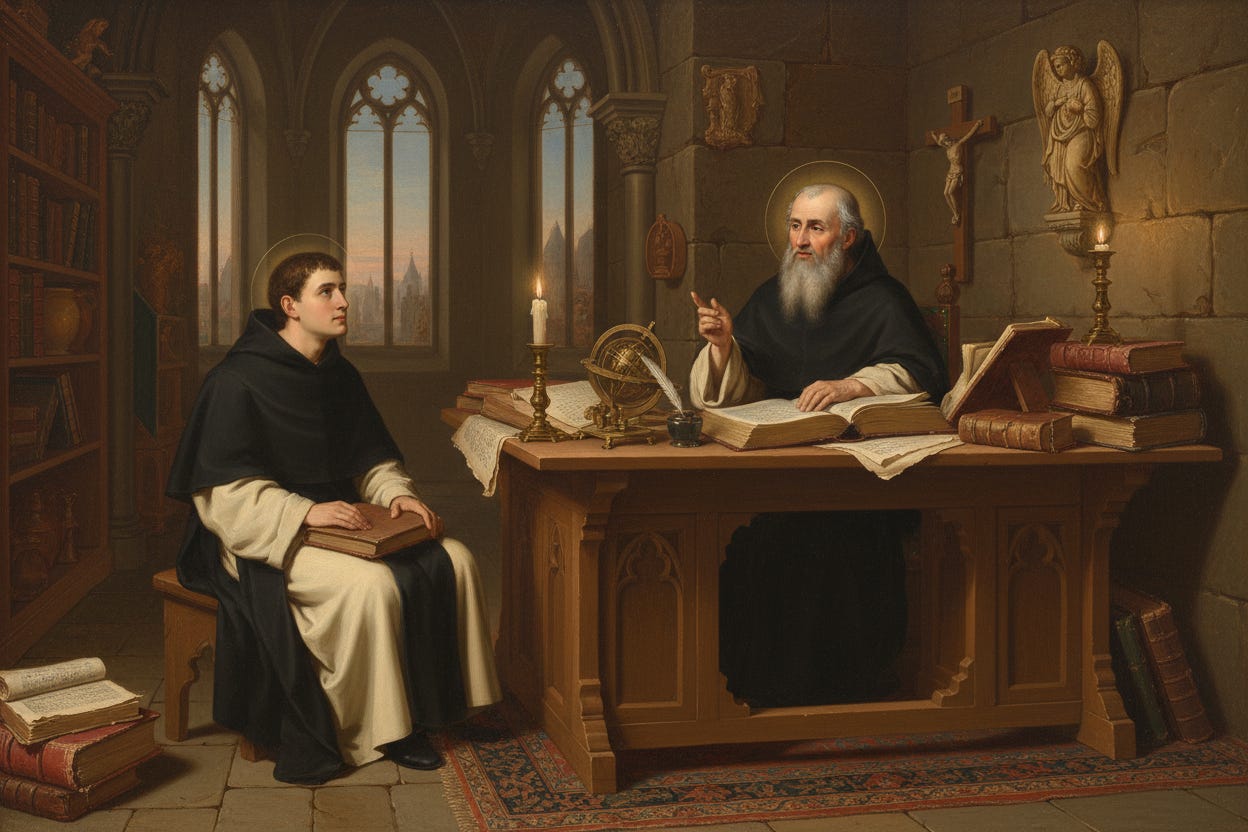
Before Saint Thomas Aquinas became known as the Angelic Doctor of the Eucharist, he was guided by the brilliance and humility of another towering figure: Saint Albert the Great. Entrusted to the Dominican Order against the wishes of his noble family, Thomas entered a world alive with the thirst for truth—one where faith and reason danced in perpetual harmony. In Cologne, under the wing of Albertus Magnus, known for his encyclopedic intellect, Thomas’ vocation took root.
Saint Albert, revered as the teacher of everything from sacred theology to the sciences, saw in Thomas not only a quiet, contemplative soul but an exceptional mind destined for greatness. The young Aquinas, mockingly called “the Dumb Ox” by his peers for his silence, soon astonished everyone—including Albert himself. Saint Albert prophetically declared, “You call him the Dumb Ox, but his bellowing in doctrine will one day resound throughout the world.” Here, in the hallowed halls of study and prayer, Thomas was formed in the twin disciplines of humility and scholarship.
Together, master and student pondered the deepest mysteries of scripture and the sacraments. Imbued with the Augustinian longing for union with God, they tirelessly sought to illuminate the doctrine of the Real Presence. Aquinas learned to submit every insight, every argument, to the authority of the Church’s Magisterium—always treating Sacred Scripture as the highest rule and source.
This intellectual apprenticeship stretched Aquinas, refining his ability to harmonize reason with revelation. Under Albert’s tutelage, Thomas developed that patient rigor, scriptural fidelity, and burning devotion to the Eucharist that would later define his theological legacy. Here, the seeds were sown for the Summa Theologiae and the soaring hymns that would echo through tabernacles across the centuries, always exalting Christ truly present in the Blessed Sacrament.
The Summa Theologiae: A Map to Heaven
To understand the spiritual genius of Saint Thomas Aquinas, one must kneel before his masterpiece: the Summa Theologiae. Composed to be a comprehensive guide for students and preachers, it draws together the depths of Sacred Scripture with the reasoned light of philosophy. In these sacred pages, Aquinas is not simply theorizing—he is laying out a navigational chart for every Catholic soul striving towards eternal life.
Every article, objection, and reply flows like a river from the profound truth at the center of our faith: that God became man to draw us into divine friendship. Aquinas moves through questions of creation, the mystery of the Incarnation, and the blazing heart of the Christian life—the Most Holy Eucharist. Here, he reverently dissects the words of Christ in the Gospels, echoing John 6: “For my flesh is true food, and my blood is true drink.” In this gaze, he invites us into the awe-inspiring reality of Transubstantiation, teaching not with cold detachment, but with the ardor of a saint who saw the Lord present upon the altar.
The Summa becomes more than a textbook; it’s a ladder rung by rung towards heaven itself. Aquinas calls us to steep ourselves in the sacraments, to aspire to the virtues, and above all, to let the love of God consumed in the Eucharist set our hearts ablaze. In his writings, faith and reason are wedded—each question met with loyal adherence to the Magisterium and a burning passion for the fullness of Truth.
Defender of the Real Presence in the Eucharist
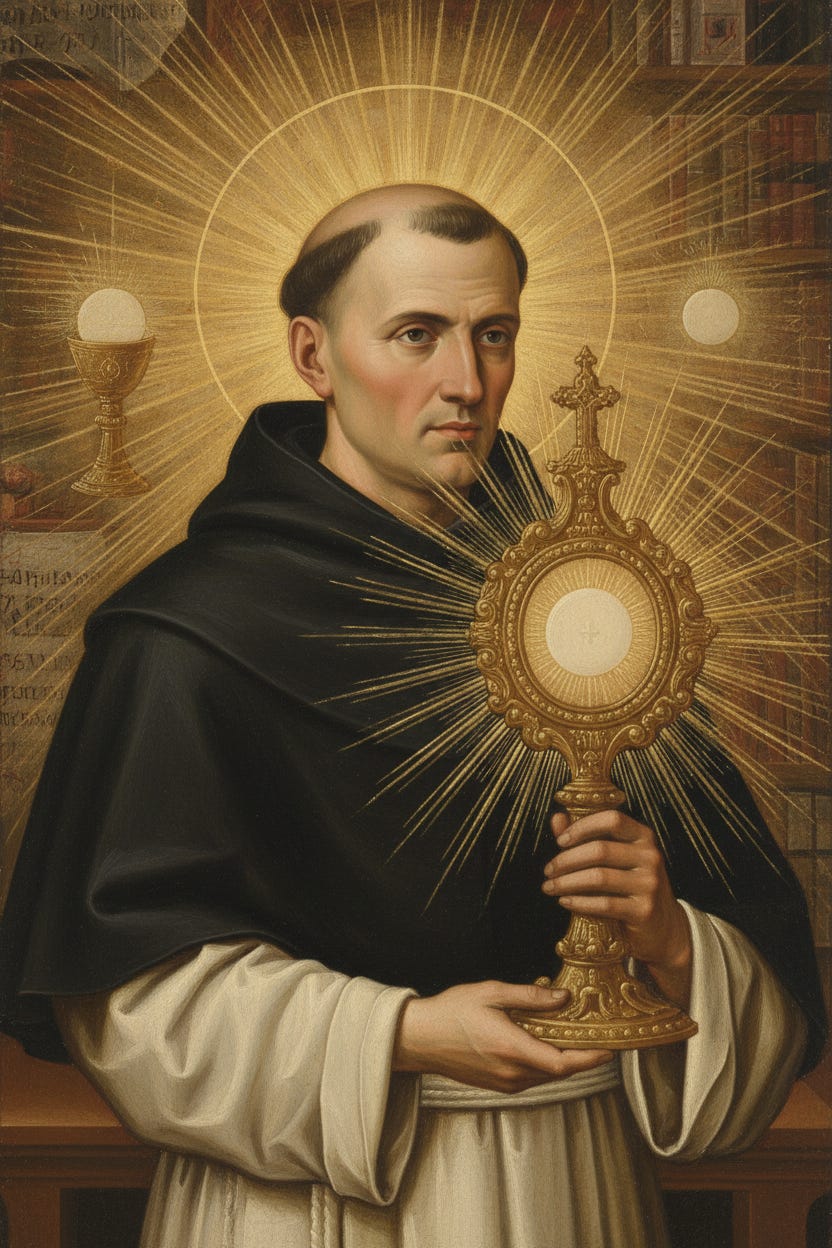
Saint Thomas Aquinas stands as a towering champion of the doctrine at the very core of Catholic worship: the Real Presence of Christ in the Eucharist. In the thirteenth century, as questions swirled and controversies arose about what the Church truly taught about the Blessed Sacrament, Aquinas became an unshakable witness to the truth. His teachings, rooted deeply in Sacred Scripture and the tradition of the Apostles, elevate the doctrine not only through reason but through profound reverence.
Drawing from Christ’s very words at the Last Supper—“This is my Body…this is my Blood” (cf. Matthew 26:26-28)—Aquinas insisted on the literal transformation that takes place upon the altar. In his magnum opus, the Summa Theologiae, he writes with clarity and conviction: “Because Christ himself said, ‘This is my body,’ it is the truth, and it is not for us to discuss how it may be so” (ST III, q. 75, a. 1). For Aquinas, the Eucharist is not just a symbol, nor a reminder, but the living Christ—Body, Blood, Soul, and Divinity—offered as the Bread of Angels to the faithful.
Aquinas’s passion for this central mystery inspired the Church’s liturgical life. The hymns he composed—O Salutaris Hostia, Tantum Ergo, and Adoro Te Devote—continue to give voice to a love affair with the Eucharistic Lord, echoing the psalmist: “Taste and see that the Lord is good!” (Psalm 34:8). Through his teaching and poetry, Aquinas fuels the hearts of believers with awe and longing for the transforming encounter with Jesus in Holy Communion.
Reading Aquinas compels us to absolute loyalty to Church teaching. He upholds the Catechism’s proclamation that the Eucharist is “the source and summit of the Christian life.” In a world rife with skepticism, his unwavering devotion becomes a beacon, calling every Catholic to fall on their knees before the tabernacle, to adore and to believe, with angelic faith, in the Real Presence of our Eucharistic King.
Hymns That Still Sing: Pange Lingua and Adoro Te Devote
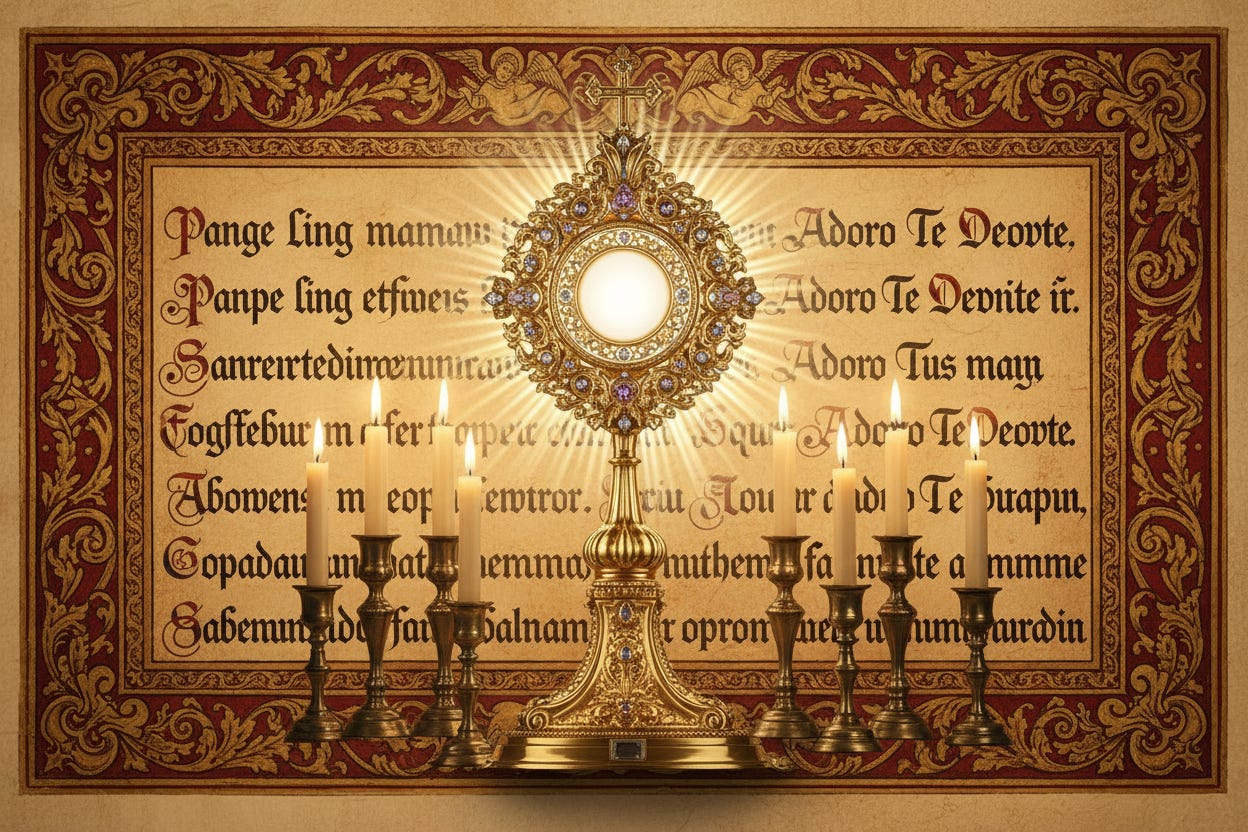
When the faithful gather before the tabernacle, there remains a sacred hush that only music can pierce. In the dramatic, living memory of the Church, few voices echo as powerfully as that of Saint Thomas Aquinas, whose Eucharistic hymns—Pange Lingua Gloriosi and Adoro Te Devote—continue to resonate centuries after he first penned their verses.
Pange Lingua Gloriosi (“Sing, My Tongue, the Savior’s Glory”) stands as a lyrical masterpiece, written for the Feast of Corpus Christi at the behest of Pope Urban IV. Each stanza is saturated with scriptural allusion: the bread and wine become flesh and blood at the altar, a mystery Aquinas called us to “sing … yet greater still.” The final two stanzas, Tantum Ergo, are intoned at Benediction to this day, professing with unwavering conviction, “Down in adoration falling/Lo! the sacred Host we hail.” Generations of Catholics know these words by heart—a living catechism in song, fortifying belief in the Real Presence as defined by the Council of Trent and the Catechism itself.
On a more intimate register, Adoro Te Devote draws the believer into a prayerful gaze before the Eucharist. Aquinas crafts its poetry with tenderness and precision—“Godhead here in hiding, whom I do adore”—encouraging all to approach the Blessed Sacrament with devotion and humble awe. Each line is a step along Saint Thomas’s own pathway to holiness, echoing his passionate love for Christ hidden under the forms of bread and wine. For every pilgrim, priest, or adorer, these hymns are not relics of a medieval past, but living prayers—timeless responses to Our Lord’s mysterious, eucharistic love.
Mystical Vision at Naples and Its Impact
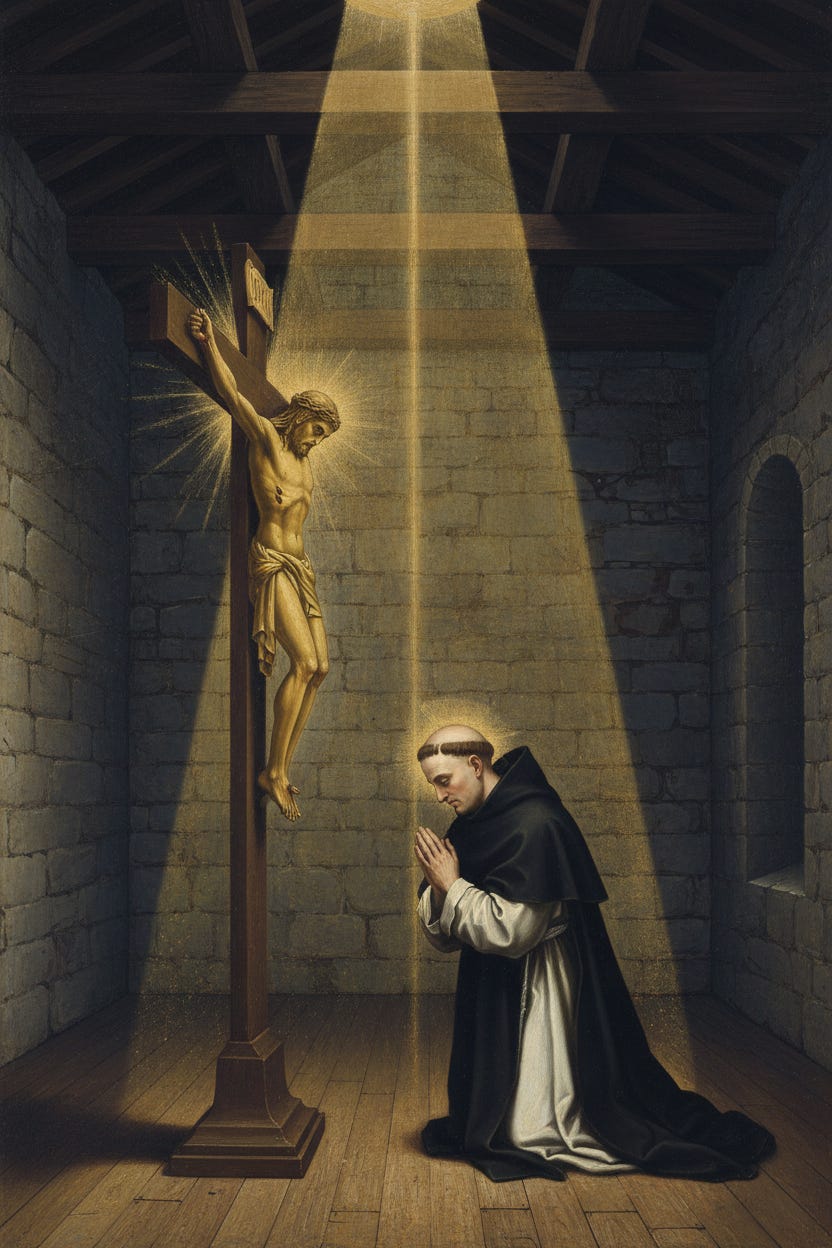
In the heart of 13th-century Naples, Saint Thomas Aquinas experienced a mystical vision that would forever shape his theology, especially his devotion to the Eucharist. It was during the final stages of his life, after laboring tirelessly over the Summa Theologica, that Aquinas—already the Doctor Angelicus—was granted a moment of divine intimacy within the silence of prayer. Witnesses recount that in the chapel, after celebrating Mass and entering deep contemplation, Aquinas was enveloped by a supernatural light. As the Lord spoke to him from the crucifix, “You have written well of Me, Thomas. What reward will you have?” the humble friar responded with words that echo through the ages: “Nothing but You, Lord.”
This encounter changed everything. Afterwards, Aquinas ceased his writing, declaring that all he had written was “so much straw” compared to the reality he had glimpsed. The impact was seismic—not merely on his personal spirituality, but on the Church’s understanding of the Eucharist. Flowing from this vision, his soaring hymns—Pange Lingua, Adoro Te Devote, Lauda Sion—gave poetic voice to the real presence of Christ in the Blessed Sacrament. Aquinas’ Eucharistic theology glows with this mystical certainty: here is Christ, truly present—Body, Blood, Soul, and Divinity.
This vision at Naples remains pivotal in Catholic tradition, a sweet and sobering reminder of Aquinas’s reverence for the Eucharist as the very heartbeat of the Church, the “source and summit of Christian life” (cf. Catechism 1324). Those who seek to adore the Lord in the tabernacle, to marvel at His humble, veiled presence, find in Thomas a guide whose witness calls us beyond words and reason, straight to the mystery at the altar.
Saint Thomas Aquinas and the Feast of Corpus Christi
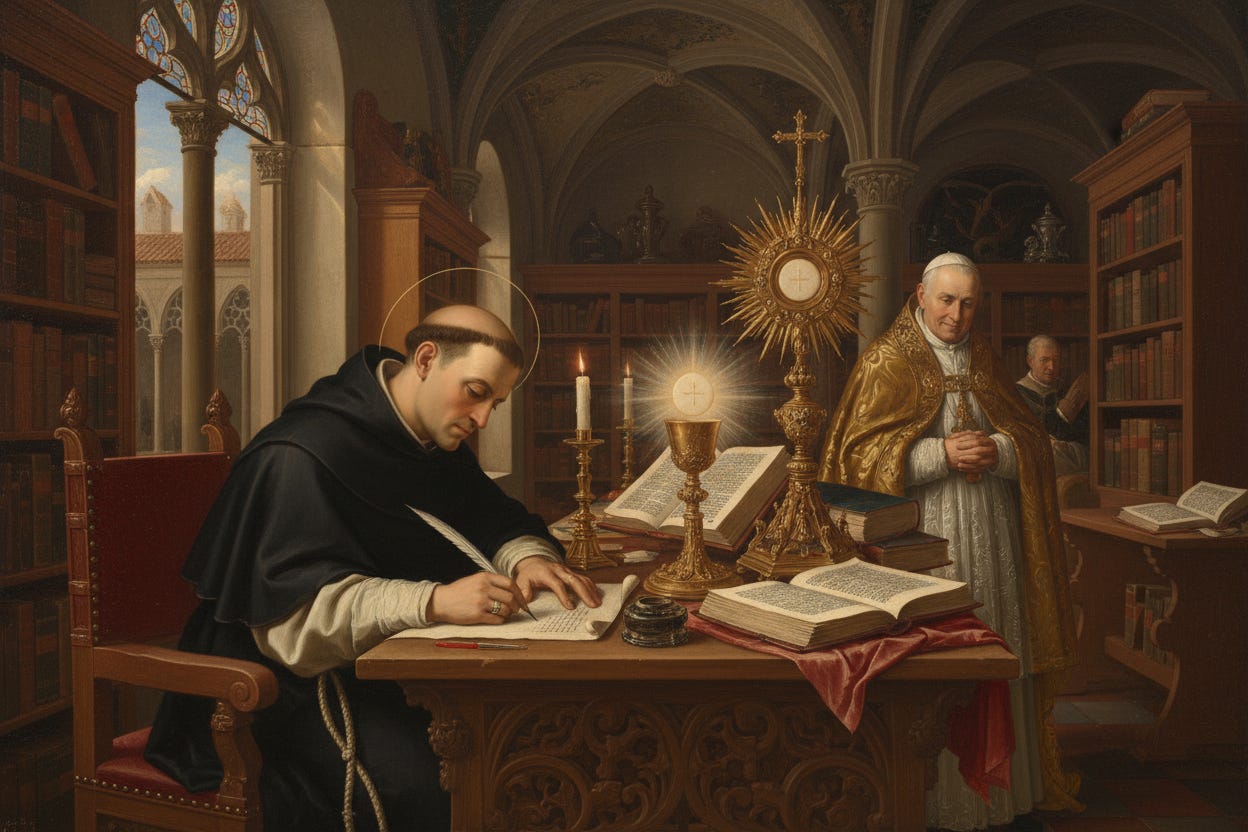
It is impossible to contemplate the luminous doctrine of Saint Thomas Aquinas without being drawn into the heart of the Eucharist, especially as it shines forth in the celebration of the Feast of Corpus Christi. In a time when doubts and debates about the Real Presence simmered throughout Christendom, Aquinas—rightly called the Angelic Doctor—rose as the Church’s greatest champion and clarifier of this central mystery. Appointed by Pope Urban IV in 1264, Aquinas was entrusted not only with crafting the liturgical texts for this new solemnity, but also with articulating the theological depths that would set Corpus Christi apart as a testament to Christ’s living presence among us.
Aquinas did more than simply obey the Holy Father’s command; he poured his entire soul into hymns and prayers that centuries later still draw the Church into awe. Who can forget lingering over the verses of Pange Lingua Gloriosi, or being moved to silence by the gentle lilt of Adoro Te Devote? Each line is saturated with scriptural allusions—drawing from John 6, the Last Supper narratives, and Saint Paul’s affirmation: “For as often as you eat this bread and drink the cup, you proclaim the Lord’s death until He comes” (1 Cor 11:26).
His hymns didn’t merely adorn the liturgy—they became catechesis in song, guiding the faithful into the mystery of transubstantiation with a clarity and poetic beauty that proves the lex orandi is truly the lex credendi: the law of prayer is the law of belief. The Divine Presence, veiled under the forms of bread and wine, stands at the apex of Aquinas’s theological system—and, through his writings and hymns, calls every generation back to the foot of the altar.
Corpus Christi is not just a feast—it is a celebration that literally centers the Church on Christ in the Eucharist, echoing Aquinas’s own conviction that “no other sacrament has greater healing power; through it sins are purged away, virtues are increased, the soul is richly endowed with every spiritual gift.” His passion for the Eucharistic Lord finds living expression in the joy and solemnity of Corpus Christi, a triumph of faith over skepticism, and a living witness to the perennial teaching authority of Holy Mother Church.
History of the Feast of Corpus Christi
Key Eucharistic Passages from the Summa
Saint Thomas Aquinas, hailed as the Angelic Doctor, gifts the Church a treasury of doctrine in his Summa Theologiae, illuminating the mystery of the Eucharist with clarity, reverence, and deep fidelity to Sacred Scripture and Tradition. Aquinas declares in Part III, Question 75, “the true Body and Blood of Christ are present in this sacrament,” not as a mere symbol, but through the astonishing reality of transubstantiation. His language is bold, yet infused with a spirit of adoration.
Aquinas draws directly from the words of Christ at the Last Supper: “This is my Body… this is my Blood” (Matthew 26:26-28), defending the Real Presence with unwavering certainty. In Article 1, he insists: “Christ himself said this is My body… and Christ is Truth itself, therefore this is the true Body of Christ.” This unyielding loyalty to Christ’s words became the rallying point for generations of Catholics.
He unfolds the necessity of the sacrament in Question 73: “The reception of the Eucharist is necessary for salvation for those to whom it is possible.” Aquinas roots this teaching in John 6:53, when Jesus proclaims: “Unless you eat the flesh of the Son of Man and drink His blood, you have no life in you.” With every phrase, Aquinas urges us to approach the altar with humility and faith, echoing the Church’s teaching that the Eucharist is truly the “source and summit of the Christian life” (cf. Lumen Gentium 11).
Throughout the Summa, Aquinas weaves together scripture, patristic wisdom, and the living faith of the Church, never wavering in his conviction that the Eucharist sustains the soul: “This sacrament is not merely a sign of Christ’s love, but contains that love, and bestows the divine life itself,” he writes. His passion for the Eucharist is palpable—a call for all Catholics to rekindle their devotion, to find in the Blessed Sacrament the burning heart of our faith.
Influence on the Catechism of the Catholic Church
When we turn the pages of the Catechism of the Catholic Church, the indelible intellectual and spiritual imprint of Saint Thomas Aquinas can be discerned at nearly every critical juncture. Known as the “Angelic Doctor,” Aquinas’s theological legacy serves as a foundation stone for the Church’s formal articulation of doctrine—no more so than in her teaching on the Holy Eucharist.
The Catechism frequently draws, both directly and indirectly, from Aquinas’s Summa Theologiae and other writings, especially where it proclaims: “The mode of Christ’s presence under the Eucharistic species is unique… He is present in a true, real, and substantial manner: his Body and his Blood, with his soul and his divinity…” (Catechism 1374). This profound language echoes Aquinas’s own distinction between substance and accidents, his defense of transubstantiation, and his passionate clarity that “[t]he presence of Christ by the power of his word and the action of the Holy Spirit is guaranteed under the Eucharistic species” (cf. Catechism 1375).
Aquinas’s unwavering reverence for Sacred Scripture and trust in the magisterium ring out in the Catechism’s Eucharistic teachings, where the interplay of mystery and rational conviction—so central to Summa Theologiae—is preserved. Where Aquinas taught, “[S]ense fails; faith alone supplies,” the Catechism instructs the faithful to approach the Sacrament in an attitude of adoration, thanksgiving, and complete surrender—“the Eucharist is the source and summit of the Christian life” (Catechism 1324).
In short, the Catechism’s luminous, Christ-centered clarity exists because it stands on the shoulders of Aquinas’s unwavering logic and burning devotion. The heart of Eucharistic doctrine beats with the rhythm Aquinas set down centuries ago— one truth, one faith, sustained and safeguarded for every generation.
Lessons for Modern Evangelizers
Saint Thomas Aquinas, often hailed as the “Angelic Doctor,” offers enduring wisdom for Catholics dedicated to spreading the Gospel in our times. Centuries ago, Aquinas poured his intellect and heart into deepening the Church’s understanding of the Eucharist. Today, his luminous insights can guide modern evangelizers—whether parish volunteers, catechists, or faithful disciples—who yearn to set hearts ablaze for Christ.
Aquinas teaches us the profound power of clarity and charity. He meticulously harmonized Scripture, tradition, and reason, refusing to let faith be diluted or distorted by passing trends. His writings demonstrate how to proclaim the truth without compromise, while always considering the needs and questions of his listeners. Evangelizers today are called to the same mission: to present the fullness of Catholic teaching with both conviction and compassion, honoring the unity of the Church and the dignity of each soul.
Meditating on the Eucharist was the wellspring of Aquinas’ ministry. He drew strength from worship, adoration, and contemplation before the True Presence, famously declaring, “Nothing but You, Lord”—and in doing so, shaped every word, every action in service of Christ. We, too, are invited to anchor our efforts in the Real Presence: only from the altar can we draw the grace, humility, and zeal needed for authentic evangelization.
Finally, Aquinas stood unwaveringly loyal to the Magisterium, submitting his own brilliance to the authority of the Church. This humble obedience models a path for today’s evangelizers, reminding us that fidelity is not a limitation, but the channel through which God’s truth flows most purely to the world.
Let us look to Saint Thomas Aquinas, especially in this age of confusion and hunger for meaning. His devotion to the Eucharist, his witness to truth, and his fervent intellect shine as a beacon—illuminating the arduous but glorious path of evangelization in the modern world.
Conclusion: Saint Thomas Aquinas—A Pillar of Eucharistic Faith
Saint Thomas Aquinas shines as a radiant beacon on the journey of Catholic faith—a true Angelic Doctor of the Eucharist whose theological mastery invites us to deeper adoration. His wisdom, documented through classic texts and his beloved hymns, draws us back to the very core of Catholic belief: the true presence of Christ in the Eucharist, which the Catechism rightfully calls the “Source and Summit of Faith” (CCC 132).
At Journeys of Faith, we walk in the footsteps of such giants, lighting the way for all who yearn to know, love, and serve Our Eucharistic Lord. Aquinas’s unwavering fidelity to the Magisterium and passionate devotion to the Blessed Sacrament challenges us to become living tabernacles, carrying Jesus to the world with one heart, one mind, one spirit, and with one vision.
May we echo Saint Thomas Aquinas’s humble prayer: “Grant, O Lord, that I may see, believe, hope and love You, above all things.” As you deepen your own relationship with Christ, know that we at Journeys of Faith remain steadfast companions on your pilgrimage, offering scriptural resources, virtual pilgrimages, and a community grounded in the heavenly call of sanctification. Let us adore Him—present, real, and loving in the Eucharist.